Thanks to the generosity of donors to the diocesan Living Christ capital campaign, three distinct but complementary projects are restoring and enhancing Our Lady, Queen of the Most Holy Rosary Cathedral, the mother church of the Diocese of Toledo. The interior restoration was unveiled on November 1, 2026, and the other two projects are in progress.
Cathedral Restoration
On November 1, 2026, the Solemnity of All Saints, Bishop Daniel E. Thomas dedicated the new altar and blessed the restored Our Lady, Queen of the Most Holy Rosary Cathedral. The pews filled and people stood along the side aisles as Catholics from across northwest Ohio gathered to celebrate at the mother church of the Diocese of Toledo.
Made possible by the generosity of donors to the diocesan Living Christ capital campaign, the restoration brings historic furnishings back into use and places the tabernacle once again at the center of the sanctuary. The new altar, the restored baptismal chapel and the return of the historic bishop’s chair each reveal how the Cathedral’s art and architecture express the faith celebrated here.
Read about the dedication Mass and blessing of the restored Cathedral
The New Altar of Sacrifice
The new freestanding altar stands three steps higher than the former platform, giving worshippers a clearer view from the pews. Directly above it is the great Crucifixion scene painted on the ceiling, a reminder that Christ’s sacrifice on the Cross is made present in the Eucharist celebrated at the altar.
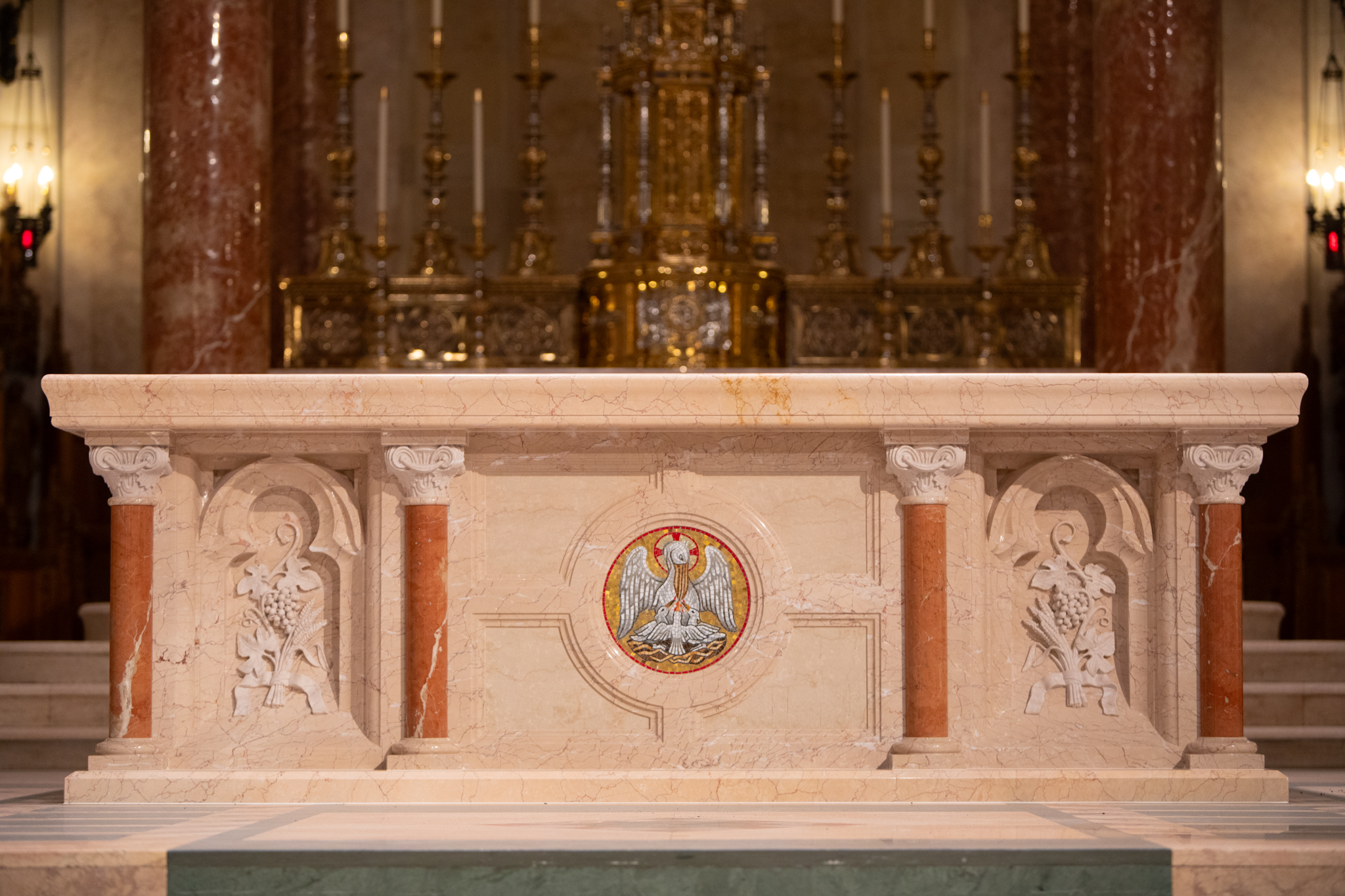
Made from Italian marbles selected to complement the sanctuary, the altar bears two Venetian glass mosaics. On the front is the Pious Pelican, an ancient symbol of Christ giving Himself for us. Look for the same image on the bishop’s chair and in the Crucifixion scene overhead. The mosaic on the back honors the Holy Family through the Sacred Heart of Jesus, the Immaculate Heart of Mary and the Most Chaste Heart of St. Joseph.
During the dedication Mass, Bishop Thomas placed relics of Pope St. John Paul II and St. Teresa of Calcutta within the altar. He met both saints during his years in Rome.
The Tabernacle, Crucifix and Altar of Repose
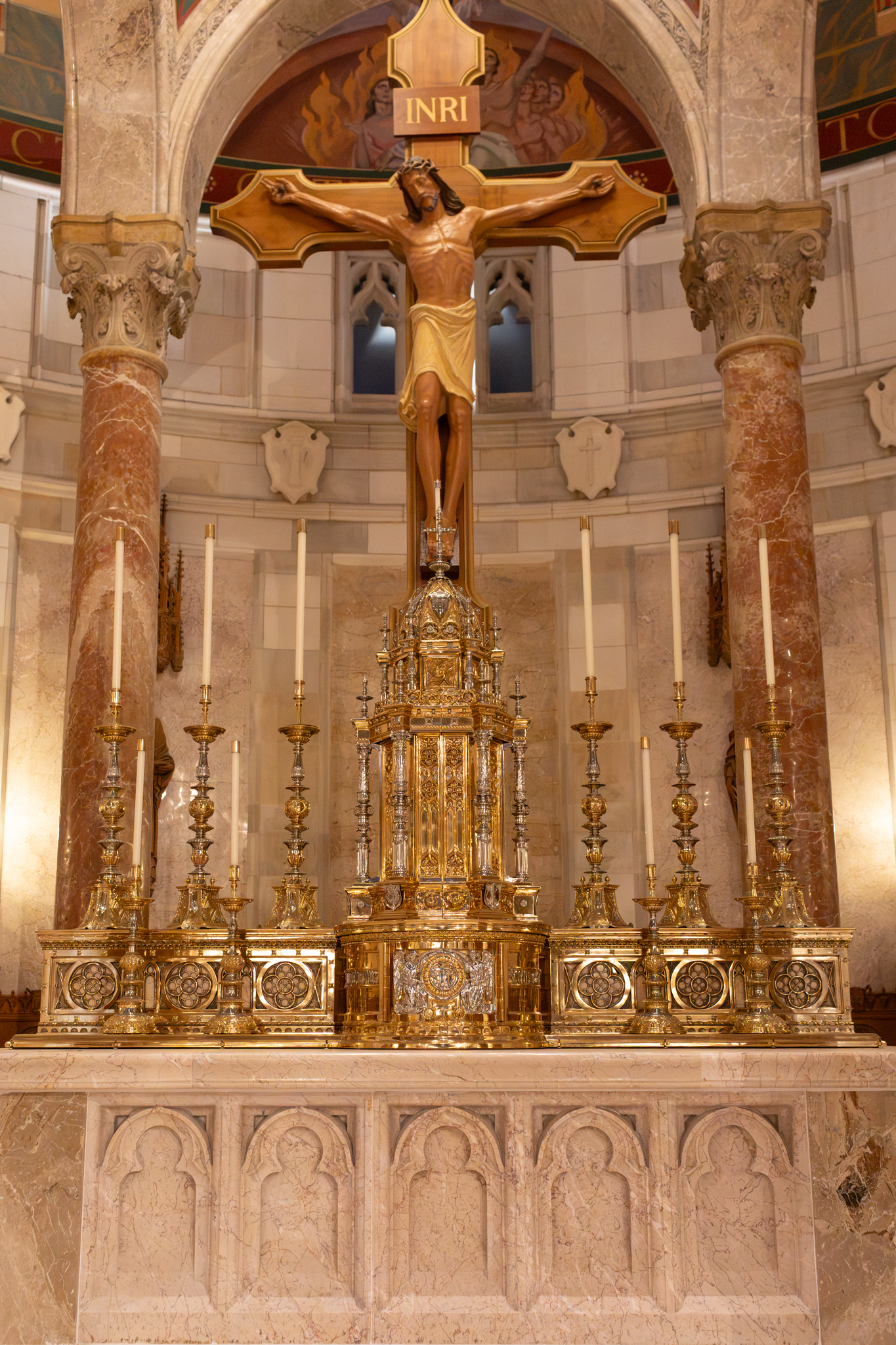
The tabernacle and crucifix have returned to their historic positions beneath the baldacchino, the ornate canopy at the center of the sanctuary. The crucifix above the tabernacle makes visible the connection between Christ’s sacrifice on the Cross and His presence in the Blessed Sacrament.
The Cathedral’s original altar, now the Altar of Repose, once again supports the tabernacle. It was restored to its original dimensions and reunited with its original shelves and candles.
The Baptismal Font and Chapel
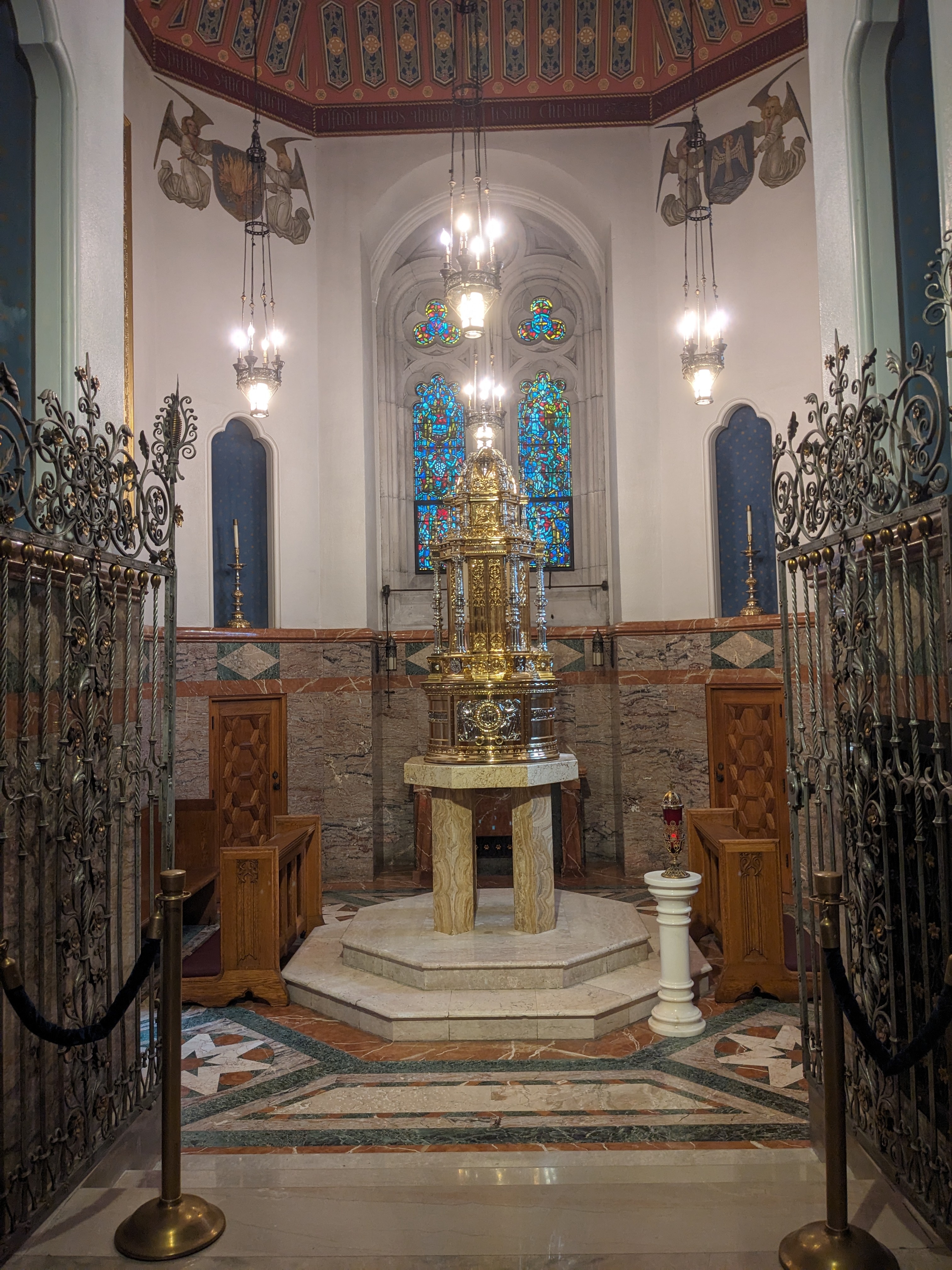
The baptismal font has returned to its original home in the Baptismal Chapel. Both the chapel and the font have eight sides, a traditional Christian symbol of the new life received in Baptism. The chapel floor descends toward the font, which rises at its center, recalling how we die and rise with Christ in Baptism. The stained-glass windows depict scenes that help tell the story of the sacrament.
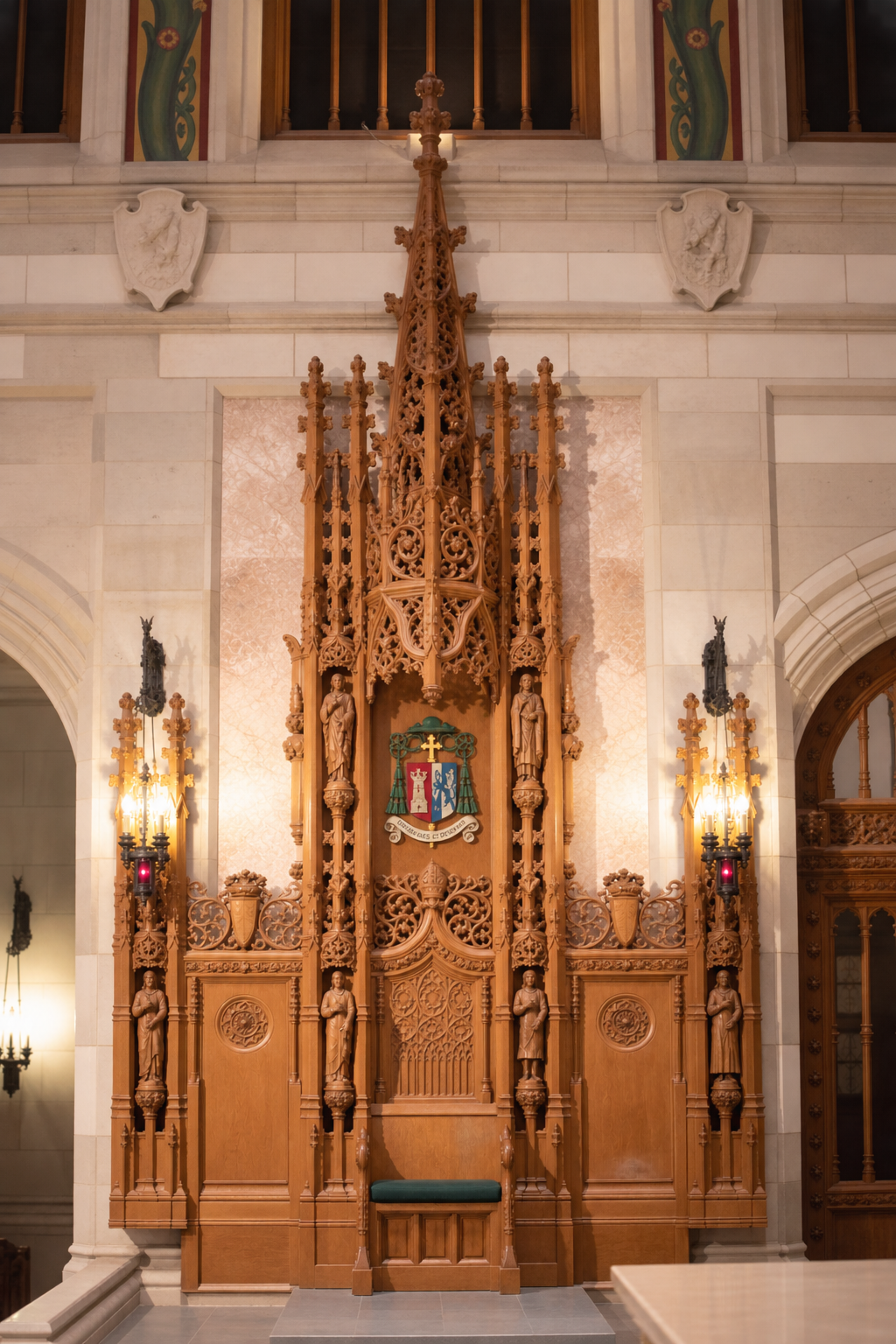
The Historic Bishop’s Chair
The original cathedra, or bishop’s chair, has been restored to use in its historic location. The chair gives a cathedral its name and signifies the bishop’s role as teacher and shepherd of the local Church.
Bishop Thomas’s coat of arms is displayed on the chair. Above it, the carved pelican echoes the mosaic on the new altar, and the saints carved around the chair offer examples of leadership and service.
The Pulpit
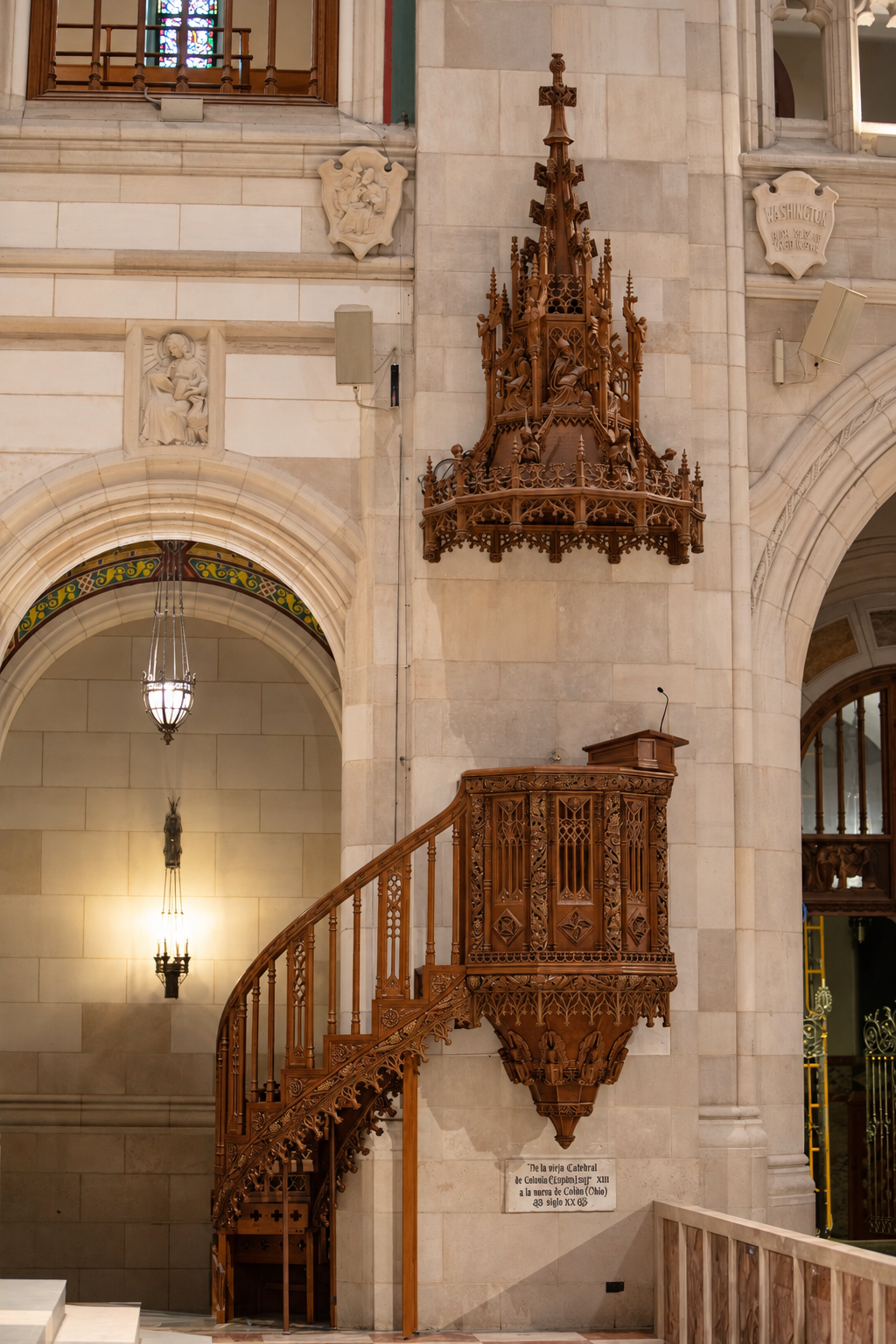
Carved from white oak from Germany’s Black Forest, the pulpit has moved one pillar back and been raised three steps to its original height. Its canopy features St. John the Evangelist and the four great Latin Doctors of the Church: St. Gregory the Great, St. Augustine, St. Jerome and St. Ambrose.
The Altar Rail and Pews
With the removal of the former platform, rows of pews have returned to the front of the Cathedral. The restored altar rail once again marks the threshold between the nave, where the congregation gathers, and the sanctuary, where Mass is celebrated at the altar.
The Skinner Organ and Choir Chamber
The choir and organ console have returned to the historic choir chamber, whose vaulted ceiling helps carry the sound of voices and organ through the Cathedral. The chamber’s stained glass honors figures from the Church’s musical tradition, including St. Cecilia and Pope St. Gregory the Great.
Built in 1930, the Cathedral’s Ernest M. Skinner organ underwent a restoration completed in 2025. Muller Pipe Organ Company removed, cleaned and restored its 4,884 pipes, refurbished its internal mechanisms and built a new console that preserves the historic appearance. Additional Skinner pipes in the rear balcony fulfill part of the original plan for the instrument.
Enhanced Lighting
Lighting has been enhanced throughout the Cathedral, making it easier to see the details of the sanctuary and the artwork throughout the church.
Luminous Mysteries of the Rosary
The second project is the addition of the Luminous Mysteries of the Rosary, to be depicted on the five vaults of the ceiling of the Cathedral Narthex (vestibule). The addition of the five Luminous Mysteries, given to the Church by Pope John Paul II in 2002, completes the depiction of all 20 of the Mysteries of the Rosary at Rosary Cathedral, including the already existing Joyful, Sorrowful, and Glorious Mysteries.
Installation of Air Conditioning
The third project is to install air conditioning throughout the Cathedral, which has long been a hoped-for addition. It is important to maintain a controlled temperature and environment to preserve the art and the recently restored historic Skinner organ, and to provide for the comfort of worshippers.